
It’s the opposite.
Over time, they solve more complex problems, support a wider range of business challenges, develop stronger methodologies, and become increasingly valuable to their clients.
Ironically, that growth often creates a new challenge.
The business evolves.
The positioning doesn’t.
This was the challenge facing a Bangalore-based Fractional COO and Business Operations Consultant with more than twelve years of experience helping founder-led businesses improve execution, accountability, operational efficiency, leadership alignment, and sustainable growth.
The expertise had evolved significantly over the years.
The market’s understanding of the business had not.
What initially appeared to be a visibility challenge ultimately became a positioning, communication, and perception challenge.
Industry
Finance & Advisory
Location
Bangalore, India
Services Delivered
Discovery & Business Audit
Positioning Strategy
Service Architecture Refinement
Website Communication Strategy
Founder Thought Leadership
Sales Communication Framework
Authority Building Strategy
Client Background
The client was a Bangalore-based Fractional COO and Business Operations Consultant working primarily with founder-led businesses navigating growth, operational complexity, leadership challenges, and execution bottlenecks.
Over the years, the scope of work had expanded considerably.
What initially began as operational consulting had evolved into a combination of:
- Business strategy
- Leadership alignment
- Systems development
- Process optimization
- Team accountability
- Growth execution
- Founder advisory
The consultant had become deeply embedded within client businesses and was often viewed as a trusted strategic partner rather than an external advisor.
Most clients came through referrals.
Client retention remained strong.
The business itself was performing well.
Yet a recurring pattern continued to emerge.
Prospective clients struggled to understand exactly where the consultant fit within their business.
The Challenge
The consultant initially approached us seeking support with thought leadership, authority building, and website communication.
The assumption was understandable.
More visibility would create more opportunities.
Before recommending any communication strategy, we conducted a detailed audit covering:
- Website communication
- LinkedIn presence
- Service architecture
- Founder positioning
- Sales conversations
- Discovery calls
- Client journey
- Competitor positioning
The findings revealed a deeper challenge.
The business had evolved significantly over the years.
Its communication had not.
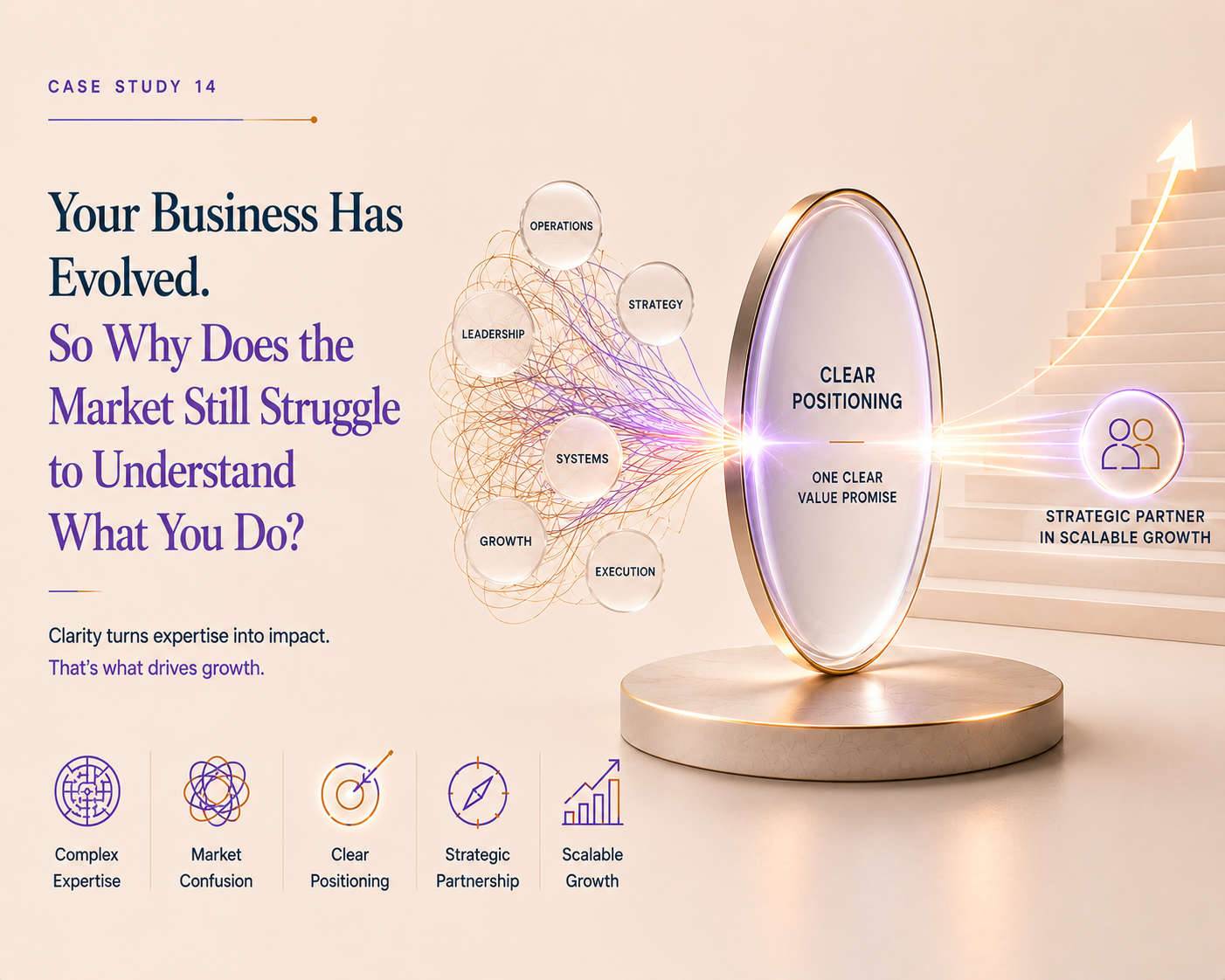
The consultant was attempting to communicate multiple capabilities simultaneously:
- Operations
- Strategy
- Leadership
- Systems
- Growth
- Team performance
- Execution
Each capability was valuable.
Together, they created confusion.
The market was seeing multiple services.
It wasn’t seeing one clear business proposition.
What We Found During Discovery
One insight became apparent almost immediately.
Existing Clients Described the Business Very Differently Than the Website Did
When we reviewed client feedback, testimonials, and engagement outcomes, a clear pattern emerged.
Clients rarely described the consultant through service categories.
They rarely spoke about process optimization, operational frameworks, or systems implementation.
Instead, they talked about outcomes.
They talked about:
- Bringing structure to growing businesses
- Creating accountability across teams
- Improving execution discipline
- Reducing operational chaos
- Helping leadership teams align
- Building businesses capable of scaling
The consultant was describing services.
Clients were describing transformation.
The two narratives were not aligned.
The Business Had Outgrown Its Original Positioning
This became one of the most significant findings of the engagement.
The positioning reflected an earlier version of the business.
A version that no longer represented the value being delivered.
Over time, the consultant had become:
- More strategic
- More involved in leadership decision-making
- More influential in growth planning
- More embedded within business operations
- More valuable during periods of scale
However, the communication still reflected a narrower operational consulting identity.
The business had matured.
The positioning had not.
The Market Could Not Clearly Categorize the Business
During competitor analysis and buyer journey reviews, we discovered another challenge.
Prospective clients often struggled to place the consultant into a familiar category.
Some viewed the business as:
- An operations consultant
- A business coach
- A strategist
- A project manager
- A leadership advisor
The reality was more nuanced.
The consultant delivered value across multiple areas of a business.
However, because the communication lacked a central narrative, prospective clients were left to create their own interpretation.
That interpretation varied significantly from one prospect to another.
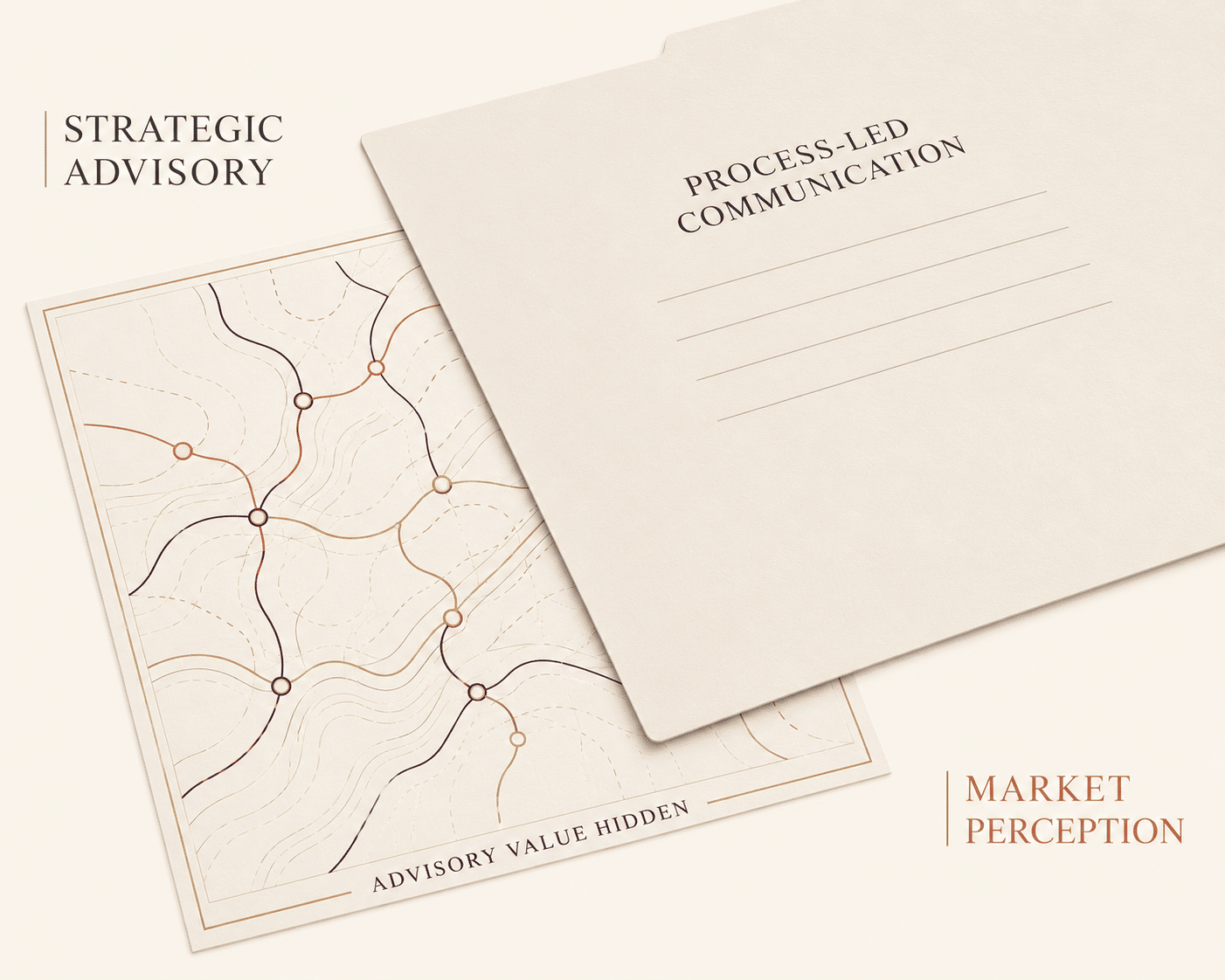
The Consultant’s Strongest Thinking Was Hidden Inside Client Engagements
The most valuable insights, frameworks, and methodologies were being shared privately during advisory sessions, workshops, and leadership discussions.
Very little of that expertise was visible before a prospect engaged with the business.
As a result, potential clients were being asked to trust expertise they had not yet experienced.
This created unnecessary friction throughout the buying journey.
Our Diagnosis
The business did not have a visibility problem.
It had a clarity problem.
More content would not have solved it.
More traffic would not have solved it.
More visibility would simply have introduced additional prospects into an experience that lacked clear positioning.
The challenge was not generating attention.
The challenge was helping the market understand the true value of the business.
There was a growing gap between:
- What the consultant delivered
- How clients experienced the value
- How the market perceived the business
That gap had quietly become a growth constraint.
Strategic Intervention
Rather than immediately developing content, we focused on clarifying the business narrative.
The engagement included:
- Positioning refinement
- Service architecture restructuring
- Website communication strategy
- Founder authority positioning
- Thought leadership framework
- Sales communication alignment
- Client journey mapping
- Authority-building content ecosystem
The objective was not to simplify the business.
The objective was to make a complex business easier to understand.

What Changed?
The first shift involved moving away from service-led communication.
Instead of explaining activities, the communication began focusing on business outcomes.
The revised positioning emphasized:
- Operational clarity
- Business scalability
- Leadership alignment
- Execution excellence
- Sustainable growth
- Organizational maturity
The website was restructured around business challenges rather than service categories.
Founder visibility increased through thought leadership focused on the realities of scaling founder-led businesses.
The service architecture became easier to understand.
Sales conversations became more consistent.
The business narrative became significantly clearer.
Most importantly, the market began seeing the consultant the way existing clients already did.
As a strategic partner helping businesses scale with greater confidence, structure, and control.
Business Impact
The transformation created stronger alignment between expertise and market perception.
Key outcomes included:
- Better quality enquiries
- Improved positioning clarity
- Stronger founder authority
- More effective sales conversations
- Reduced buyer confusion
- Greater differentiation within the consulting market
- Better alignment between service delivery and communication
Most importantly, prospective clients stopped asking:
“What exactly do you do?”
And started asking:
“Can you help us solve this challenge?”
Leadership Insight
Many consulting businesses evolve faster than the way they communicate.
Over time, expertise expands.
Capabilities mature.
Client outcomes improve.
Yet communication often remains anchored to an earlier version of the business.
The result is confusion.
The strongest consulting brands are not necessarily those with the broadest expertise.
They are often the ones that communicate their expertise with the greatest clarity.
Because when the market clearly understands the value you create, growth becomes significantly easier to sustain.