
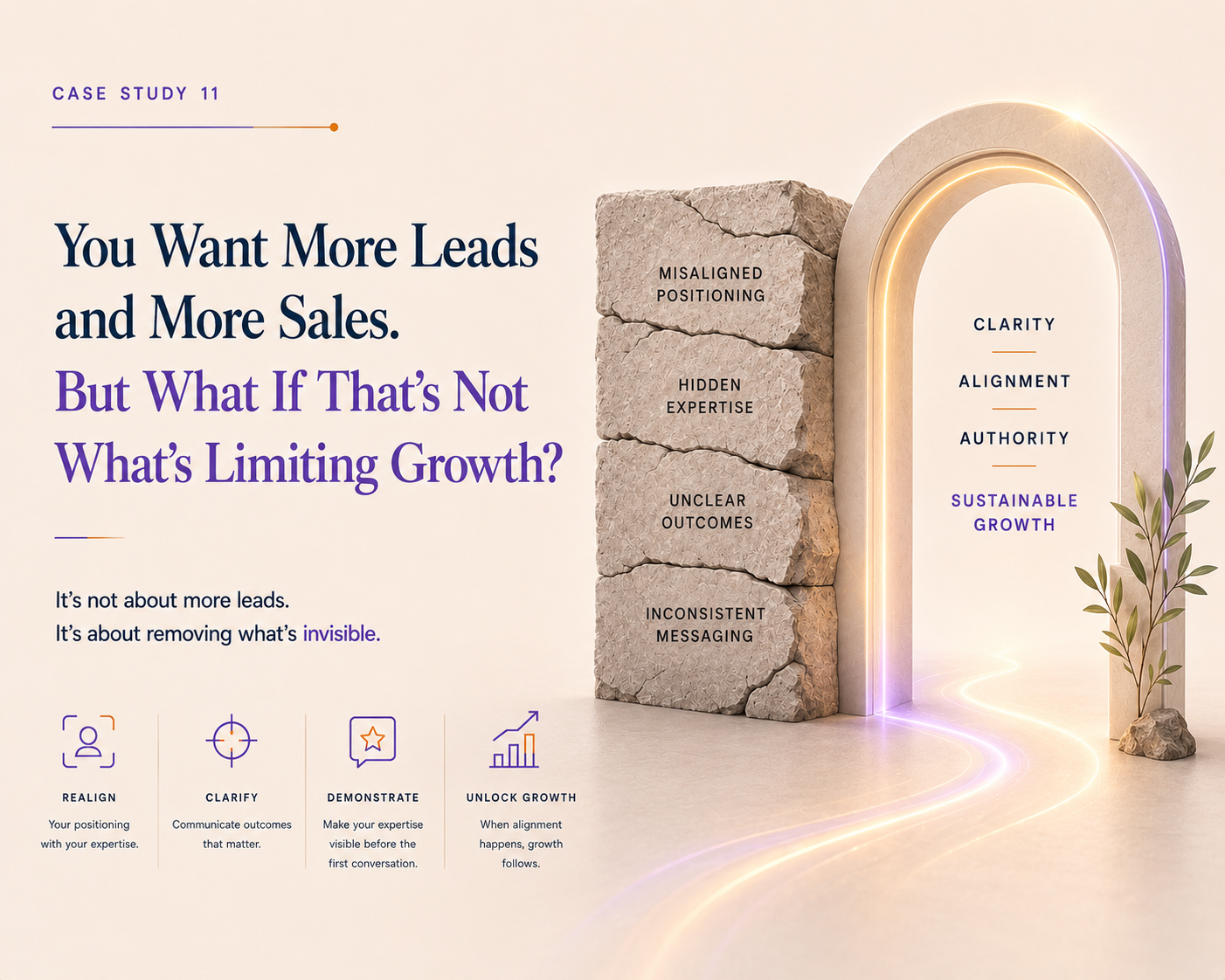
More marketing.
More content.
More advertising.
More leads.
More sales conversations.
The assumption is simple:
“If we can generate more opportunities, growth will follow.”
But what if the real problem isn’t lead generation at all?
What if growth is being constrained by something much deeper?
This was the challenge facing a UK-based executive coaching and leadership advisory practice that had built a strong reputation over seven years through referrals, client outcomes, and long-term professional relationships.
The founder believed the business needed more visibility.
Our discovery process revealed something very different.
Industry
Finance & Advisory
Location
United Kingdom
Services Delivered
Business Discovery & Growth Audit
Brand & Positioning Communication
Website Communication Strategy
Founder Thought Leadership
Sales & Strategic Communication Assets
Client Journey Communication Mapping
Client Background
The client was an experienced executive coach and leadership advisor working with business owners, senior professionals, and leadership teams.
Over the years, the founder had developed proprietary frameworks, delivered strong client outcomes, and built a business largely driven by referrals and word-of-mouth recommendations.
The expertise was evident.
The client outcomes were real.
The credibility existed.
However, growth had started to plateau.
Like many founders facing this situation, the immediate assumption was:
“I probably need more visibility, more content, and more leads.”
Before recommending any communication strategy, we began with a deeper discovery process.
The Challenge
The founder approached us looking for support with visibility, authority building, and thought leadership.
On the surface, it sounded like a lead-generation challenge.
However, during the discovery process, several contradictions began to emerge.
The business was already generating enquiries.
The website was attracting visitors.
Referrals continued to come in.
Professional networks remained active.
Yet conversion remained inconsistent.
Something wasn’t adding up.
The challenge wasn’t attracting attention.
The challenge was converting understanding into action.
What We Found During Discovery
Rather than jumping directly into content creation, we conducted a detailed audit of:
- Website communication
- Founder positioning
- LinkedIn presence
- Sales conversations
- Service architecture
- Client journey
- Market positioning
What we found was revealing.
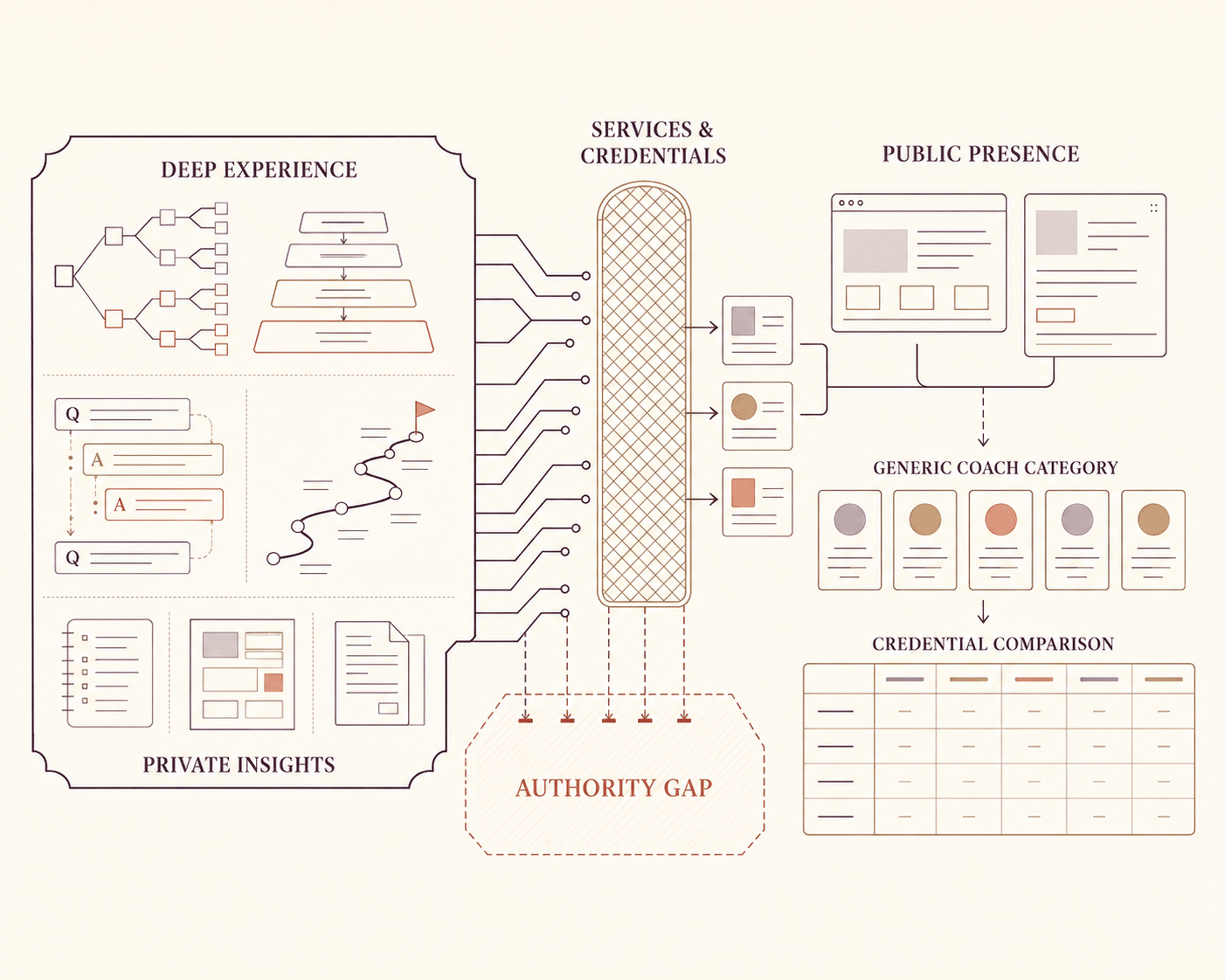
The business did not have a visibility problem.
It had multiple small communication, positioning, and perception gaps that were quietly slowing growth.
Gap 1: The Founder Was Being Perceived Differently Than the Value Being Delivered
The market saw a coach.
Clients experienced a strategic advisor.
The expertise being delivered was significantly broader than the expertise being communicated.
Gap 2: The Best Insights Were Hidden Inside Conversations
Prospects only discovered the founder’s strongest thinking after engaging.
Very little of that expertise was visible before the first meeting.
Gap 3: Services Were Being Explained. Outcomes Were Not.
The communication focused on coaching programs, sessions, and frameworks.
Prospective clients were trying to understand:
- What changes?
- What improves?
- What business outcomes can I expect?
Gap 4: Different Platforms Were Telling Different Stories
The website said one thing.
LinkedIn suggested another.
Sales conversations introduced a third perspective.
The result was confusion.
And confused prospects rarely move forward confidently.
Our Diagnosis
The founder believed the business needed more leads.
Our assessment suggested otherwise.
Generating more traffic would have amplified the same underlying challenges.
More visibility would simply have brought more people into a customer journey that lacked clarity and alignment.
The business wasn’t struggling because people couldn’t find it.
The business was struggling because prospects couldn’t immediately understand its full value.
The issue wasn’t volume.
It was alignment.
Strategic Intervention
Rather than starting with content creation, we focused on aligning the business first.
The engagement included:
- Business discovery and growth audit
- Positioning refinement
- Communication architecture development
- Website communication strategy
- Founder authority positioning
- Thought leadership framework
- Sales communication refinement
- Client journey redesign
The objective was simple:
Ensure that what the business delivered, what the market perceived, and what the communication conveyed were all aligned.

What Changed?
The first shift involved changing how the founder described the business.
Instead of focusing primarily on coaching services, communication began focusing on business outcomes.
The revised positioning emphasized:
- Leadership effectiveness
- Strategic clarity
- Better decision-making
- Team performance
- Executive influence
- Organizational growth
The website was restructured around client challenges rather than service descriptions.
Thought leadership content became more perspective-driven and experience-led.
Sales conversations became more consistent with the value actually being delivered.
Most importantly, the communication ecosystem became aligned.
The objective was not to create more noise.
It was to create more clarity.
Business Impact
The transformation created stronger alignment between expertise and market perception.
Key outcomes included:
- Better quality enquiries
- Stronger authority positioning
- Improved client understanding
- More consistent sales conversations
- Greater confidence during decision-making
- Stronger differentiation within a crowded market
Most importantly, the founder stopped focusing on generating more opportunities and started fixing the factors that were quietly limiting growth.
Leadership Insight
Many businesses assume growth slows down because of a lack of leads.
Sometimes that’s true.
Often it isn’t.
Sometimes growth is constrained by communication gaps.
Sometimes it’s positioning.
Sometimes it’s perception.
And sometimes it’s a combination of all three.
Before investing in more visibility, it is worth understanding whether visibility is actually the problem.
Because the fastest path to growth is not always generating more attention.
Sometimes it is creating more alignment.