A founder recently shared a challenge that many business leaders would recognise.
The company had invested considerable time and resources into its website. The design looked professional, the content had been updated, search traffic was steadily increasing, and the business was finally beginning to appear in relevant Google searches. On the surface, the website appeared to be doing exactly what it was supposed to do.
Yet something felt off.
Despite attracting visitors, the website was not generating the quality or volume of conversations the business expected. Prospects visited multiple pages, spent time browsing services, and then disappeared. The occasional enquiry arrived, but nowhere near enough to justify the attention being given to website traffic and digital visibility.
The immediate assumption was that the business needed more traffic.
More visitors would surely create more opportunities.
However, after analysing the situation more closely, a different reality emerged.
The website did not have a traffic problem.
It had a conversation problem.
This distinction matters because many businesses continue treating websites as digital brochures. Their objective is to attract attention, showcase services, and present information. Buyers, however, use websites very differently.
They visit websites to reduce uncertainty.
Before a prospect books a call, requests a proposal, or submits an enquiry, they are trying to answer a series of questions. They want to know whether the business understands their challenge, whether it has solved similar problems before, whether it can be trusted, and whether a conversation is worth their time.
In many cases, the difference between a visitor who leaves and a visitor who enquires has very little to do with design and everything to do with confidence.
The Shift Most Businesses Have Not Noticed
Ten years ago, websites played a relatively straightforward role.
They provided information.
Prospective clients would often reach out directly, ask questions, schedule meetings, and learn about the business through conversations. The website functioned as a supporting asset rather than a decision-making tool.
Today, the buying process looks very different.
Most buyers conduct significant research before ever speaking to a company. They compare alternatives, read articles, review case studies, explore social profiles, and evaluate credibility long before submitting an enquiry.
By the time a prospect reaches out, a substantial portion of the buying decision has already taken place.
This means a website is no longer just an information platform.
It has become part of the sales process.
It is often the first salesperson a business introduces to a potential client.
Unfortunately, many websites continue behaving like brochures while buyers expect them to behave like advisors.
The result is a disconnect between what businesses provide and what buyers need.
The Real Journey Visitors Take Before Starting a Conversation
Many organisations assume the process looks like this:
Traditional Assumption |
Visitor arrives |
Visitor reads |
Visitor enquires |
In reality, the journey is considerably more complex.
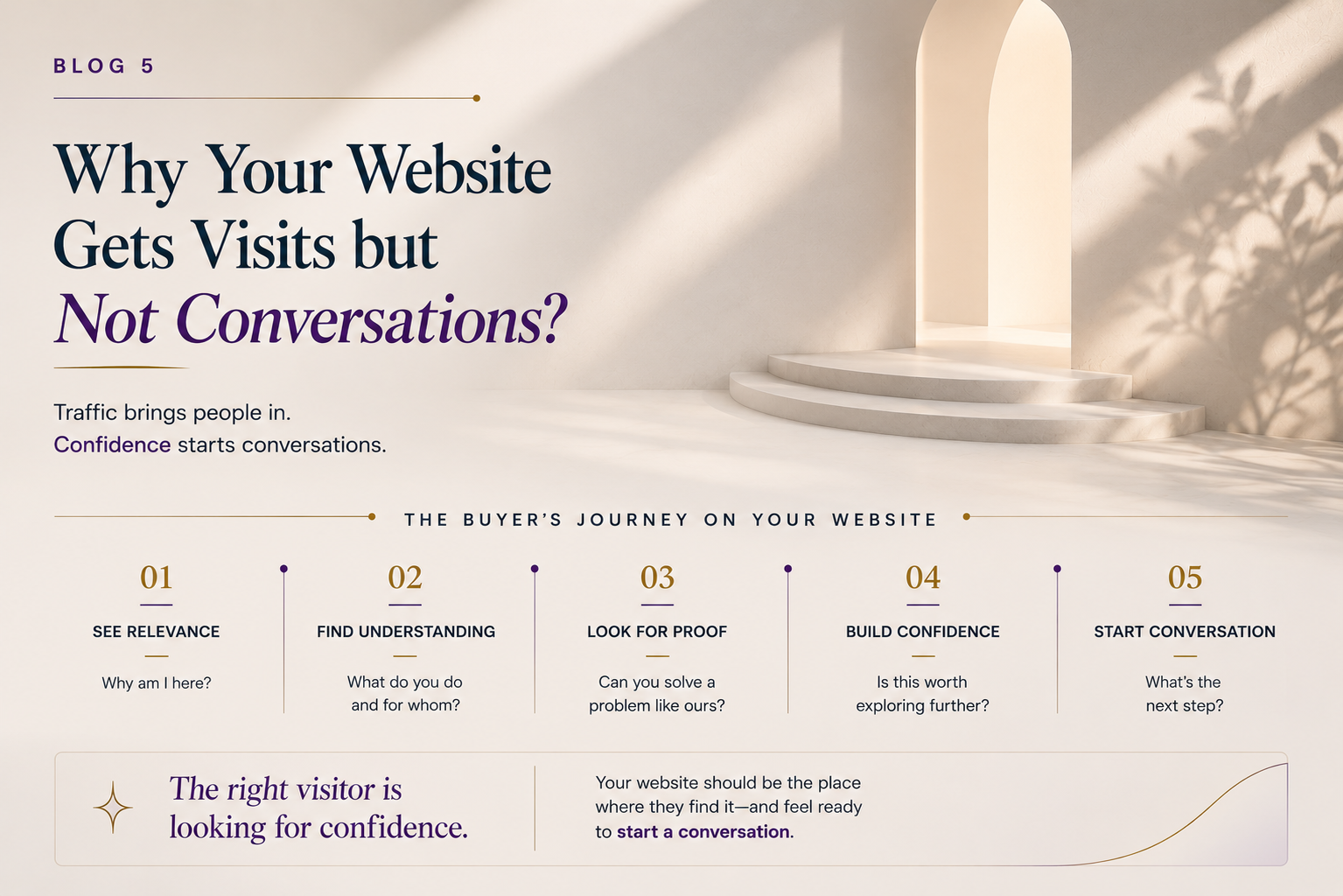
Buyer’s Actual Journey |
Visitor arrives |
Visitor evaluates relevance |
Visitor assesses understanding |
Visitor looks for proof |
Visitor develops confidence |
Visitor starts a conversation |
This distinction changes how websites should be evaluated.
Traffic becomes only the starting point.
The more important question becomes whether the website helps visitors move from awareness to confidence.
Without confidence, conversations rarely happen.
The Website Conversation Framework
One way to understand this process is through what we call the Website Conversation Framework.
Most business websites focus heavily on visibility and information. The strongest websites focus on creating momentum through each stage of buyer decision-making.
Stage | Buyer Question | Website Responsibility |
Visibility | Why am I here? | Communicate relevance immediately |
Understanding | What does this business actually do? | Create clarity |
Relevance | Is this designed for businesses like mine? | Demonstrate audience alignment |
Trust | Can they solve a problem like ours? | Provide evidence |
Confidence | Is this worth exploring further? | Reduce uncertainty |
Conversation | What should I do next? | Create a clear path forward |
Many websites perform reasonably well during the first two stages.
Far fewer succeed in the last three.
This is where opportunities are often lost.
Why Buyers Leave Without Saying Anything
One of the challenges of website performance is that businesses rarely receive feedback from visitors who choose not to enquire.
Prospects do not send emails explaining why they left.
They do not complete forms saying they were unconvinced.
They simply continue their search elsewhere.
As a result, organisations often misdiagnose the problem.
They assume the issue is traffic, advertising, search rankings, or lead generation.
Sometimes those factors contribute.
More frequently, however, visitors leave because they have not found enough evidence to justify taking the next step.
Researching a supplier, consultant, agency, or service provider involves risk. Buyers are trying to minimise that risk before committing their time.
Every unanswered question creates uncertainty.
Every vague service description creates ambiguity.
Every unsupported claim creates hesitation.
The cumulative effect is often invisible, but it significantly influences conversion behaviour.
The Difference Between Information and Confidence
A surprising number of business websites contain plenty of information and very little confidence.
There is a difference.
Information tells buyers what a business does.
Confidence helps buyers believe the business can solve their problem.
Consider the following examples:
Information | Confidence |
Service descriptions | Relevant case studies |
Company overview | Client outcomes |
Process explanations | Evidence of expertise |
Industry terminology | Practical insights |
Claims | Proof |
Most organisations invest heavily in the left column.
Buyers often make decisions based on the right.
This explains why two businesses with similar capabilities can generate dramatically different results online.
One presents information.
The other creates confidence.
The Five Questions Every B2B Website Must Answer
Regardless of industry, service offering, or business model, every website should answer five critical questions.
What problem do you solve?
Businesses often begin by describing services.
Buyers begin by evaluating challenges.
The problem should come before the solution.
Who is your work designed for?
Specificity creates relevance.
The clearer the audience, the easier it becomes for visitors to recognise themselves.
Why is your approach different?
Differentiation helps buyers compare options.
Without it, businesses become difficult to distinguish from competitors.
Why should someone trust you?
Trust rarely emerges from claims alone.
It develops through evidence, examples, expertise, and demonstrated understanding.
What should happen next?
Many websites unintentionally create friction because the next step feels unclear.
Visitors should never have to guess how to continue the conversation.
Measuring What Actually Matters
Many businesses evaluate websites using metrics such as page views, sessions, bounce rates, and traffic sources.
While useful, these measurements only describe activity.
They do not necessarily describe effectiveness.
A more useful question is:
Is the website helping the right buyers develop enough confidence to start a conversation?
That question shifts the focus away from visibility and toward business outcomes.
Because ultimately, a website’s purpose is not to attract visitors.
Its purpose is to help potential buyers move from curiosity to confidence.
Conclusion
Most businesses do not struggle because people are failing to find their websites. They struggle because visitors arrive and leave without developing sufficient confidence to continue the journey.
As buying behaviour becomes increasingly self-directed, websites play a larger role in shaping trust, credibility, and decision-making. The businesses that perform best online are not necessarily the ones attracting the most traffic. They are often the ones creating the strongest connection between visibility, understanding, trust, and action.
When a website begins functioning as a trust-building system rather than an information repository, conversations become a natural outcome rather than a hoped-for result.