
More visibility.
More listings.
More enquiries.
More advertising.
More property launches.
The logic seems straightforward.
If more people see the opportunities, more people will buy.
However, for businesses built around expertise rather than transactions, visibility is rarely the primary challenge.
The challenge is often audience alignment.
This was the challenge facing a Dubai-based real estate advisory firm with over eight years of experience helping investors, business owners, expatriates, and high-net-worth individuals make informed property decisions.
The business had developed significant expertise.
The market respected its knowledge.
Existing clients trusted its advice.
Yet much of its communication was attracting people who were looking for properties rather than people who were looking for guidance.
What initially appeared to be a visibility challenge ultimately became a positioning challenge.
The business didn’t need more prospects.
It needed the right prospects.
Industry
Consulting & Advisory
Location
Dubai, UAE
Services Delivered
Discovery & Business Audit
Positioning Strategy
Founder Authority Building
Website Communication Strategy
Thought Leadership Framework
Investor Education Content Strategy
B2B Positioning Strategy
Sales Communication Architecture
Client Background
The client was a Dubai-based real estate advisory firm serving investors, professionals, expatriates, and international buyers looking to build or diversify their property portfolios.
Unlike traditional brokerage businesses, the firm positioned itself around helping clients make better investment decisions.
Its expertise extended across:
- Market evaluation
- Investment suitability
- Portfolio diversification
- Risk assessment
- Rental yield analysis
- Wealth creation strategies
- Long-term investment planning
The firm’s strongest relationships were built through trust and advisory conversations.
Existing clients appreciated the firm’s ability to simplify complex decisions and identify opportunities aligned with broader financial objectives.
However, attracting similar clients consistently remained a challenge.
The Challenge
The founder initially approached us to strengthen thought leadership and increase visibility.
The assumption was understandable.
More visibility would generate more opportunities.
Before making recommendations, we conducted a detailed audit of:
- Website communication
- Social media presence
- Sales assets
- Founder visibility
- Client acquisition patterns
- Buyer journey
- Competitor positioning
- Industry communication trends
The findings revealed a deeper challenge.
The business was attracting attention.
But not always from the audience that valued its expertise most.
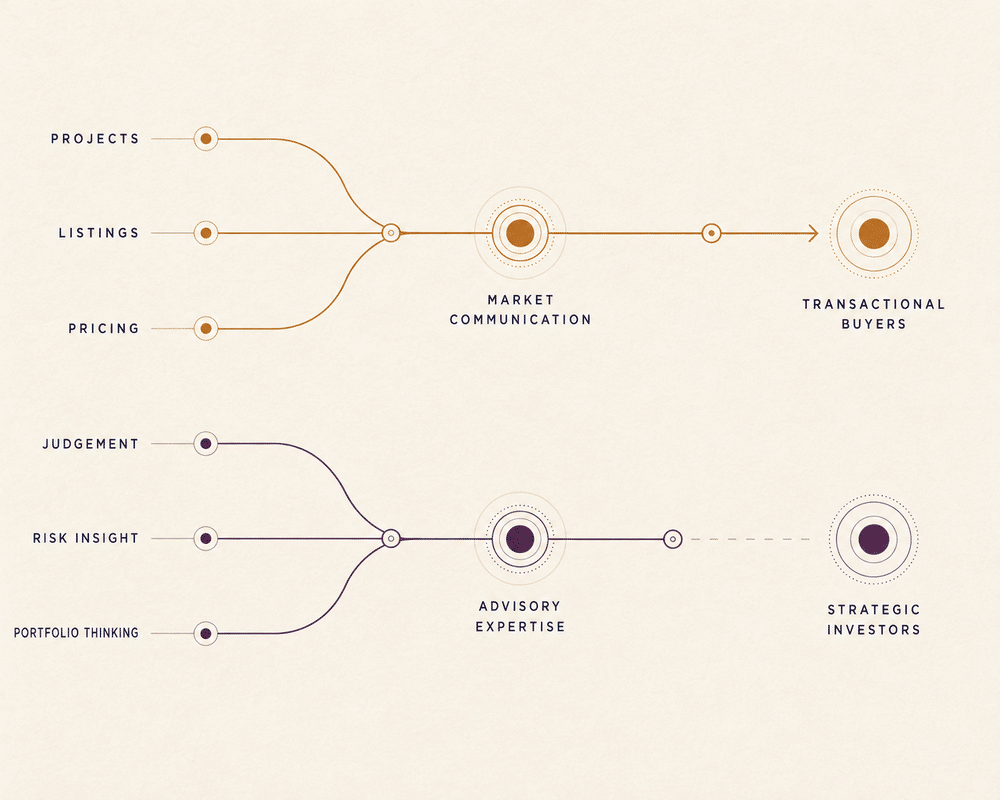
Much of the communication revolved around:
- Property launches
- Project announcements
- Investment opportunities
- Market updates
- Developer information
- Listing-driven communication
This attracted transactional buyers.
The firm’s expertise was significantly better suited to strategic investors.
What We Found During Discovery
One insight became clear almost immediately.
The Business Was Attracting Property Buyers. Its Expertise Was Designed for Investors.
When we reviewed client outcomes, testimonials, and successful engagements, a pattern emerged.
The firm’s most valuable relationships were not built with people looking for their next property.
They were built with individuals seeking informed investment decisions.
These included:
- Business owners
- Senior professionals
- Investor communities
- High-net-worth individuals
- Wealth advisors
- Family offices
- International investors
These audiences valued perspective, judgment, and strategic guidance.
Yet the communication was attracting a broader audience focused primarily on projects and pricing.
The expertise and the audience were not fully aligned.
The Advisory Process Was Creating the Value. The Properties Were Receiving the Credit.
Clients rarely described the firm’s value through the properties they purchased.
Instead, they spoke about:
- Better investment decisions
- Greater confidence
- Understanding risk
- Portfolio alignment
- Market insight
- Long-term wealth creation
The firm’s strongest asset was not access to properties.
It was the ability to help people make better decisions.
However, very little of that expertise was visible before the first conversation.
The Founder Was the Firm’s Strongest Differentiator
Another observation emerged throughout the audit.
Clients consistently referenced the founder’s perspective, judgment, and ability to evaluate opportunities objectively.
Many trusted the founder before they trusted a specific project.
Yet much of that expertise remained hidden behind listings and opportunities.
The market could see properties.
It could not clearly see the thinking behind the recommendations.
Events Were a Channel. Not the Strategy.
During the engagement, we identified investor events, networking forums, and business communities as important opportunities for visibility.
However, events alone were never the answer.
The objective was not simply to attend more events.
The objective was to establish credibility within communities where strategic investment decisions were being discussed.
Events became one component of a broader positioning strategy designed to strengthen visibility among serious investors rather than transactional buyers.
Our Diagnosis
The business did not have a lead-generation problem.
It did not have a visibility problem.
It had an audience-positioning problem.
More marketing would have increased awareness.
It would not necessarily have improved the quality of conversations.
The challenge was helping the market understand who the business was truly built to serve.
There was a growing gap between:
- The expertise being delivered
- The audience most likely to value that expertise
- The audience being attracted through existing communication Closing that gap became the primary objective.
Strategic Intervention
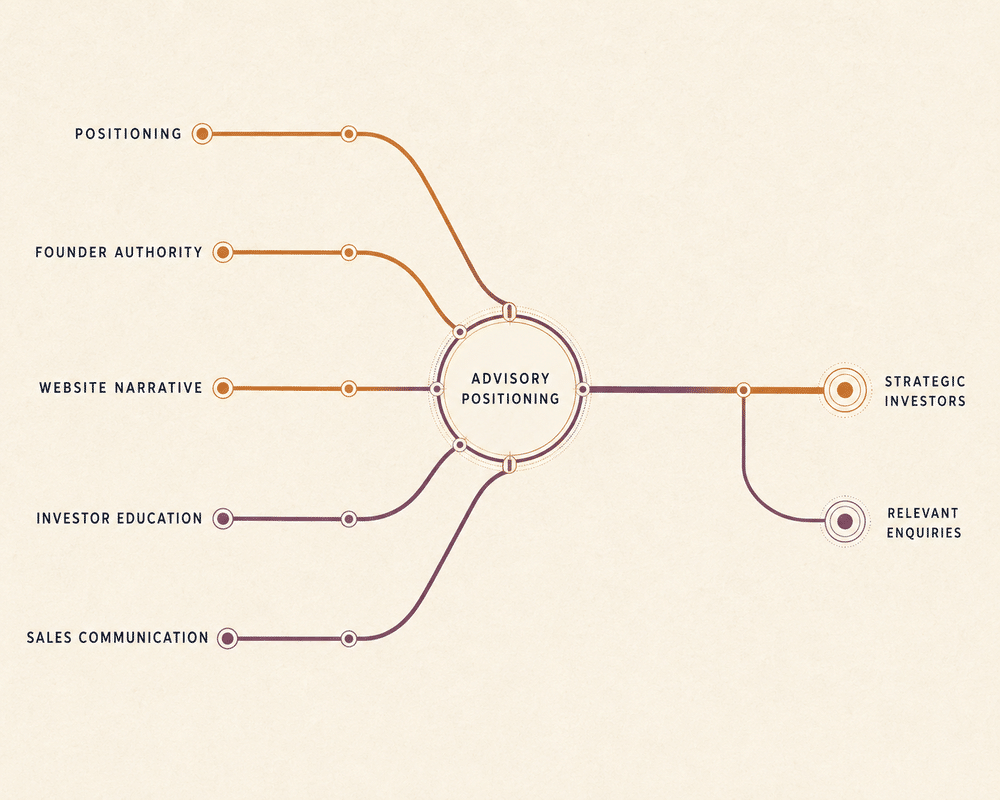
The engagement focused on repositioning the business around the audience that valued its expertise most.
The scope included:
- Positioning refinement
- Investor-focused communication strategy
- Founder authority development
- Thought leadership framework
- Website communication restructuring
- Investor education content
- B2B networking and visibility strategy
- Communication consistency framework
The objective was not simply to generate more enquiries.
The objective was to generate more relevant enquiries.
What Changed?
One of the most important shifts involved changing who the communication was designed for.
The business moved away from broadly promoting opportunities and began positioning itself as a trusted advisor to serious investors.
The revised communication focused on:
- Investment decision-making
- Wealth creation through real estate
- Portfolio diversification
- Risk evaluation
- Market intelligence
- Long-term investment thinking
- Investor education
At the same time, founder visibility increased significantly through educational content, market perspectives, thought leadership, and strategic commentary.
The website evolved from a property-focused platform into an advisory-focused platform.
Sales conversations became more strategic.
Investor communities became a priority.
Business networking channels became more intentional.
The communication shifted from:
“Here is a property opportunity.”
to
“Here is how experienced investors evaluate opportunities.”
Business Impact
The repositioning helped create stronger alignment between expertise and audience.
Key outcomes included:
- Better quality enquiries
- Stronger investor relationships
- Improved founder visibility
- Greater authority within investor communities
- Reduced transactional conversations
- More strategic client engagements
- Better alignment between expertise and target audience
Most importantly, the business stopped focusing on attracting more buyers.
It started focusing on attracting the right buyers.
Leadership Insight
Many businesses assume growth comes from reaching more people.
Often, growth comes from reaching the right people.
The challenge is not always visibility.
Sometimes it is positioning.
Because attracting the wrong audience more efficiently rarely creates better business outcomes.
The strongest businesses are not always those speaking to the largest audience.
They are often the ones speaking most clearly to the audience that values them the most.