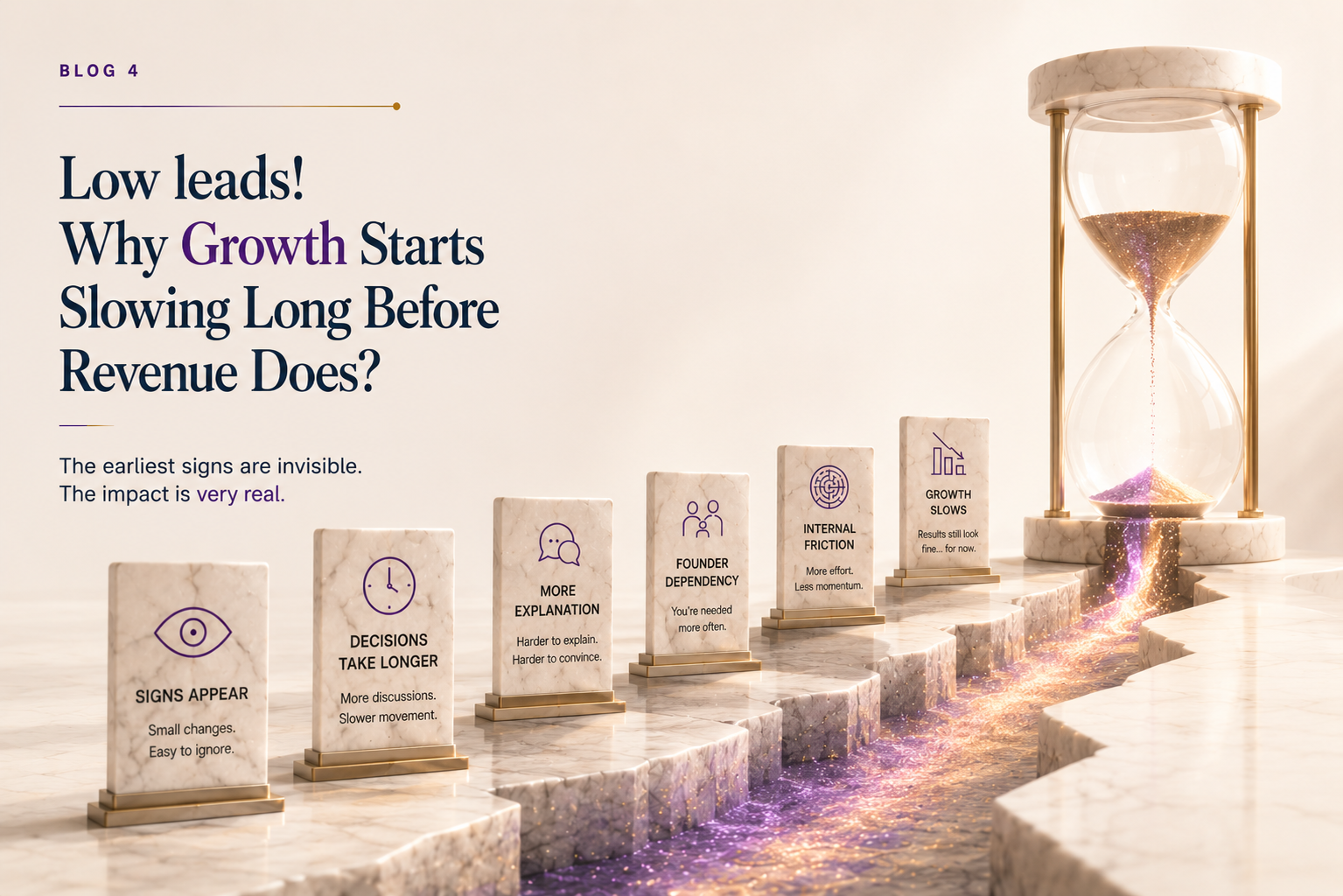
Revenue will decline. New enquiries will reduce. Sales pipelines will weaken. Clients will leave. The signs, they imagine, will be visible enough to trigger action.
In reality, growth rarely slows this way.
For many businesses, growth begins slowing long before revenue reflects it. The organisation continues generating income, serving clients, and appearing healthy from the outside. Financial reports remain positive. Teams remain busy. Projects continue moving. Yet beneath these encouraging indicators, something begins to change.
Decisions take longer than they once did. Sales conversations require more explanation. New employees take longer to become productive. Founders find themselves repeatedly involved in discussions they thought the business had already outgrown. Teams become busier, but not necessarily more effective.
Most organisations dismiss these developments as normal consequences of growth. Complexity, after all, is expected when businesses expand.
The problem is that complexity and growth are not the same thing.
One is a sign of expansion.
The other is a sign of progress.
Many businesses successfully achieve the first while gradually undermining the second.
The Hidden Difference Between Expansion and Growth
The terms expansion and growth are often used interchangeably, but they represent different realities.
Expansion refers to an increase in activity. A business adds services, hires employees, enters new markets, adopts new technologies, or acquires additional clients. The organisation becomes larger and more complex.
Growth, however, refers to an increase in capability. The business becomes better at creating value, making decisions, serving clients, and operating efficiently.
In an ideal situation, expansion and growth occur together.
Yet many organisations discover that as they expand, maintaining growth becomes increasingly difficult.
The reason is not a lack of effort.
Most teams are working harder than ever.
The reason is that every stage of expansion introduces additional complexity, and complexity places demands on the organisation that were not present before.
What worked when the company had ten employees often stops working when it has fifty. What worked with one service line becomes less effective when there are six. What could once be communicated through informal conversations suddenly requires structure, documentation, alignment, and shared understanding.
The organisation becomes larger, but not necessarily clearer.
And clarity plays a far greater role in sustainable growth than most leaders realise.
Why Businesses Become Harder to Run as They Become More Successful
One of the more surprising realities of business growth is that success often creates the very conditions that later slow progress.
In the early stages of a company, information moves quickly. Teams are small. Founders remain close to clients. Decisions happen rapidly because everyone understands the business in roughly the same way.
As the organisation grows, that shared understanding becomes more difficult to maintain.
New hires bring different experiences and assumptions. Departments begin specialising. Teams develop their own priorities and language. Different client segments require different approaches. Service offerings become more sophisticated. The business starts operating through layers rather than direct relationships.
None of these developments are negative. In fact, they are often signs of maturity.
The challenge is that every layer added to the organisation creates additional opportunities for misunderstanding, inconsistency, and misalignment.
At first, these issues appear insignificant. A proposal takes slightly longer to prepare. A client receives a slightly different explanation of a service. A manager interprets a strategic priority differently from another manager.
Individually, these moments seem harmless.
Collectively, they begin creating friction.
And friction is one of the earliest indicators that growth is becoming harder than it needs to be.
The Cost of Friction Is Rarely Immediate
Financial problems attract attention because they are visible.
Operational friction is more subtle.
Businesses rarely notice the opportunities that take longer to close, the prospects who leave because the value proposition was unclear, or the internal delays that gradually increase the cost of execution.
The impact emerges slowly.
Projects require additional oversight.
Teams become increasingly dependent on a small group of individuals who understand how everything connects.
Meetings multiply because decisions require more coordination.
Processes become more complicated in an attempt to manage increasing complexity.
The organisation continues moving forward, but every step requires more effort than before.
Many leaders interpret this as the unavoidable cost of scale.
Sometimes it is.
More often, it is the result of complexity growing faster than organisational clarity.
The Organisational Asset Most Businesses Neglect
When leaders think about assets, they usually think about people, technology, intellectual property, capital, or customer relationships.
Few think about clarity.
Yet clarity may be one of the most valuable organisational assets a business can possess.
Clarity influences how employees make decisions when leaders are not present. It influences how sales teams describe value, how marketing communicates positioning, how managers prioritise work, and how clients experience the organisation.
Without clarity, growth becomes increasingly dependent on individuals.
With clarity, growth becomes increasingly supported by systems.
This distinction becomes especially important as businesses scale.
An organisation that relies primarily on individual knowledge can grow, but its growth will eventually become constrained by the capacity of those individuals.
An organisation that translates knowledge into shared understanding creates a stronger foundation for long-term expansion.
The Debt Businesses Rarely Realise They Are Accumulating
Financial debt is easy to identify because it appears on a balance sheet.
There is another form of debt that accumulates more quietly.
Every time a service evolves without updating how it is explained.
Every time a team develops its own interpretation of the business.
Every time organisational complexity increases without creating corresponding clarity.
Every time new employees rely on informal explanations rather than shared understanding.
A small amount of inconsistency may seem harmless.
Over time, however, these inconsistencies compound.
The organisation becomes increasingly dependent on tribal knowledge. Communication becomes fragmented. Decision-making slows. Growth requires greater effort.
The business continues operating successfully, but its ability to scale efficiently begins eroding beneath the surface.
This is not a communication problem.
It is a business problem with communication consequences.
Questions Worth Asking Before Growth Becomes Harder
Businesses often ask how they can accelerate growth.
A more useful question may be whether anything inside the organisation is quietly making growth more difficult.
Leadership teams should periodically examine questions such as:
Question | Why It Matters |
Do different teams describe the business consistently? | Reveals organisational alignment |
Can new employees quickly understand how value is created? | Indicates clarity of knowledge transfer |
Are founders still required to explain critical aspects of the business? | Highlights dependency risks |
Has complexity increased faster than understanding? | Reveals scalability challenges |
Are clients experiencing the same business the leadership team believes they are building? | Identifies perception gaps |
The answers to these questions often reveal more about future growth than current revenue numbers.
Conclusion
Growth problems rarely begin when revenue declines. They often begin much earlier, when complexity starts increasing faster than clarity.
Because the effects appear gradually, many organisations fail to recognise them until growth begins feeling unusually difficult. Teams become busier, processes become heavier, and leaders find themselves investing increasing effort to achieve outcomes that once felt easier to attain.
The businesses that scale most effectively are not necessarily those that avoid complexity. They are the ones that continuously create alignment, understanding, and clarity as complexity grows. In doing so, they ensure that growth remains sustainable rather than becoming increasingly dependent on effort alone.