
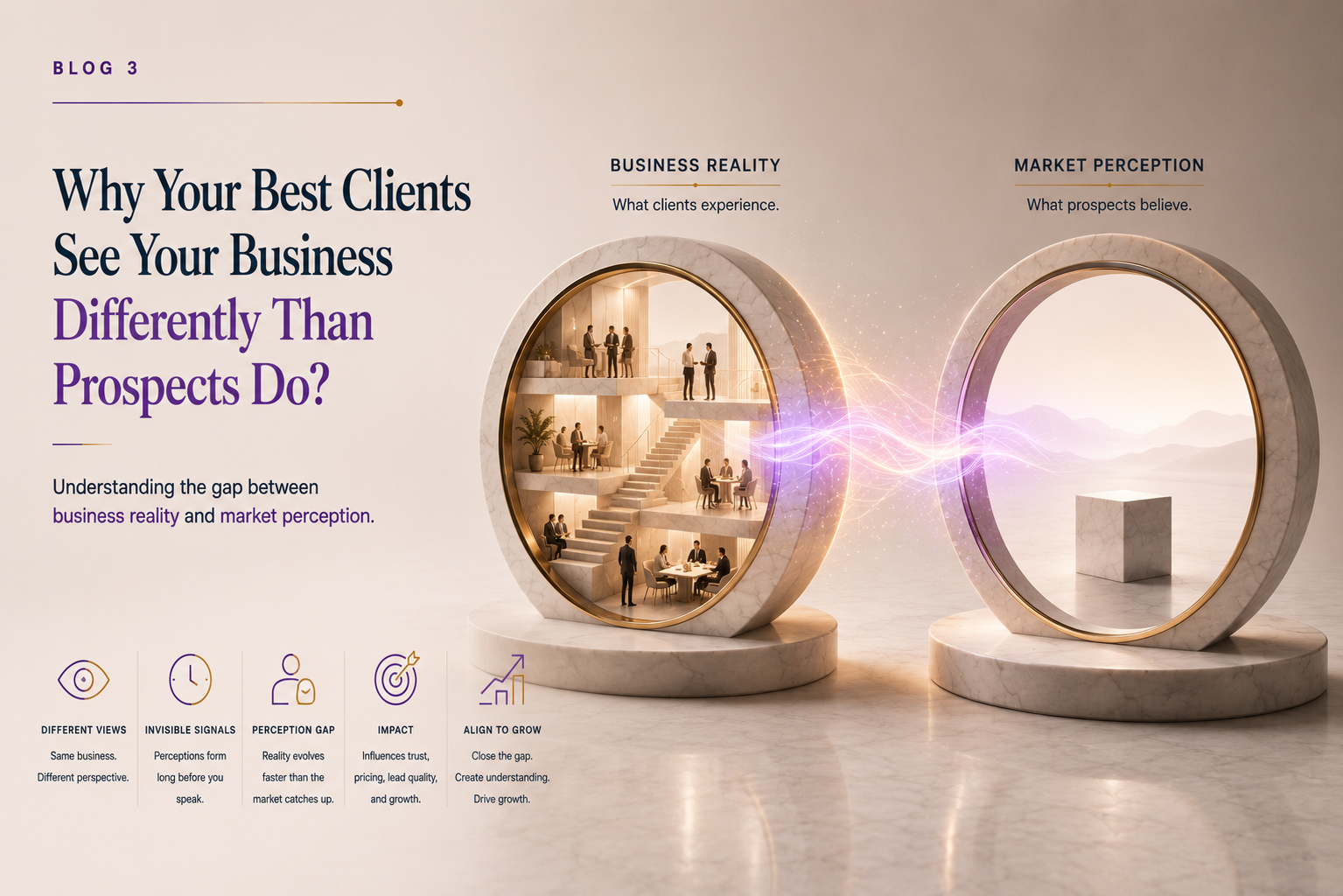
A few years ago, a founder shared an observation that seemed contradictory at first.
The business had grown steadily for almost a decade. Client retention was strong, referrals continued to arrive, and many projects expanded beyond their original scope. Existing clients trusted the team and frequently described the company as a strategic partner rather than a service provider.
Yet new business development remained frustratingly inconsistent.
Prospective clients often questioned pricing. Some struggled to understand what differentiated the company from competitors. Others compared the firm to businesses operating at entirely different levels of capability. A few prospects would show strong interest initially, only to disappear after the first conversation.
What made the situation particularly confusing was that existing clients rarely expressed these concerns.
The people who knew the company best seemed to see tremendous value in its work. The people who knew the company least often saw something entirely different.
The founder initially assumed this was a marketing issue. More visibility seemed like the logical answer. If more people became aware of the business, surely more opportunities would follow.
However, as the leadership team examined the situation more closely, a different pattern began to emerge.
The challenge was not visibility.
The challenge was perception.
The market was evaluating a version of the business that no longer reflected the organisation the company had become.
This situation is far more common than many business leaders realise.
In fact, some of the most capable organisations in the market operate with a significant gap between who they actually are and how they are perceived by prospective buyers.
That gap influences everything from trust and pricing power to lead quality and sales conversion.
More importantly, it often develops quietly, making it difficult to identify until growth begins to feel harder than it should.
Every Business Exists Twice
Most business leaders spend the majority of their time improving the actual organisation.
They invest in talent, strengthen delivery capabilities, develop systems, refine processes, improve client experience, and solve increasingly complex problems. Over time, these efforts create a stronger business.
Yet every organisation exists in two forms.
The first is the business that employees and clients experience every day. This version is shaped by delivery quality, expertise, responsiveness, strategic thinking, and results.
The second is the business that exists in the minds of prospective buyers.
This version is shaped by something entirely different.
It is formed through websites, proposals, referrals, social presence, sales conversations, industry reputation, thought leadership, and countless small interactions that occur before a client ever engages.
The challenge is that these two versions of the business rarely evolve at the same pace.
While leaders focus on improving operations, delivery, and capability, the market often continues operating on assumptions formed months or even years earlier.
As a result, the perception held by prospective buyers can lag significantly behind the reality of the business.
Business Reality | Market Perception |
What the organisation has become | What buyers believe it is |
Built through experience and delivery | Built through visible signals |
Changes continuously | Changes gradually |
Known internally | Assumed externally |
When these two realities align, growth tends to feel natural.
When they diverge, businesses often experience friction that is difficult to explain.
Why Perception Influences Buying Decisions More Than Most Leaders Realise
Business leaders understandably place significant emphasis on capability.
After all, capability determines whether the organisation can deliver results.
Buyers, however, encounter a different challenge.
Before they can evaluate capability, they must first decide whether a business is worth evaluating.
This distinction matters because buyers rarely possess complete information.
They do not see internal processes.
They do not observe how teams collaborate.
They do not experience client relationships.
They do not witness the expertise that exists behind the scenes.
Instead, they rely on signals.
These signals help them make assumptions about credibility, trustworthiness, competence, and relevance.
The process is not unique to business purchasing. It reflects how people make decisions generally.
When information is limited, perception fills the gaps.
This explains why two organisations with similar capabilities can receive dramatically different responses from the market.
One appears credible, specialised, and trustworthy.
The other appears generic, difficult to understand, or difficult to compare.
The difference often has less to do with actual capability and more to do with how that capability is perceived.
Five Places Where Prospects Form Opinions Before Speaking to You
One of the reasons perception becomes difficult to manage is that it is shaped long before a formal sales conversation begins.
By the time a prospect reaches out, they have already started forming conclusions.
Some of the most influential sources include:
1. Your Website
For many buyers, the website functions as a first impression.
It answers fundamental questions:
- What does this business do?
- Who is it designed for?
- Why does it matter?
- Why should I trust it?
When these answers are unclear, uncertainty increases.
2. Referrals
Referrals are often viewed as lead sources.
In reality, they are perception transfers.
Someone else’s understanding of your business becomes the prospect’s starting point.
3. Case Studies
Case studies communicate more than outcomes.
They communicate capability, thinking, credibility, and relevance.
Well-constructed case studies help buyers imagine what working with the organisation might feel like.
4. Thought Leadership
Articles, insights, interviews, and educational content influence how expertise is perceived.
They demonstrate not only knowledge but also perspective.
5. Sales Conversations
By the time a prospect enters a sales conversation, many perceptions have already been formed.
The conversation often reinforces existing beliefs rather than creating entirely new ones.
Why More Visibility Does Not Always Improve Perception
When growth slows, many businesses respond by increasing visibility.
More content.
More campaigns.
More advertising.
More outreach.
Visibility is important.
However, visibility and perception are not interchangeable.
Increasing visibility without addressing perception can amplify the wrong message.
The market may become more aware of the business while continuing to misunderstand it.
This explains why some organisations generate significant attention but struggle to attract the right opportunities.
Awareness grows.
Understanding does not.
The objective, therefore, should not simply be to become more visible.
It should be to become more accurately understood.
Closing Thoughts
Many organisations assume that perception is a branding issue.
In reality, it is often a business issue.
Perception influences trust. Trust influences decisions. Decisions influence growth.
The strongest businesses are not always those creating the most visibility. They are often the ones ensuring that the value experienced by existing clients is visible to prospective buyers as well.
When the market begins seeing the same business that clients experience, sales conversations become easier, differentiation becomes clearer, and growth becomes less dependent on explanation.
In many cases, the challenge is not improving the business itself.
The challenge is ensuring the market has caught up with what the business has already become.