
A founder once shared a frustration that many business leaders quietly carry.
His company had been operating for more than a decade. The team was experienced, client retention was strong, and the business had successfully delivered complex projects across multiple industries. Yet despite the depth of expertise within the organisation, the company continued losing opportunities to competitors that appeared smaller, less experienced, and in some cases significantly newer.
His question was straightforward.
“How are they winning these clients when we clearly have more experience?”
It is a reasonable question.
Most business owners assume that buyers compare organisations based on expertise, capability, track record, and delivery quality. The assumption seems logical because these are often the factors business leaders themselves value most.
However, buyers rarely evaluate businesses the same way business owners evaluate themselves.
In reality, most buyers begin with a much simpler question.
“Which option feels easiest to understand?”
Only after that question has been answered do they begin exploring expertise, methodology, process, and capability.
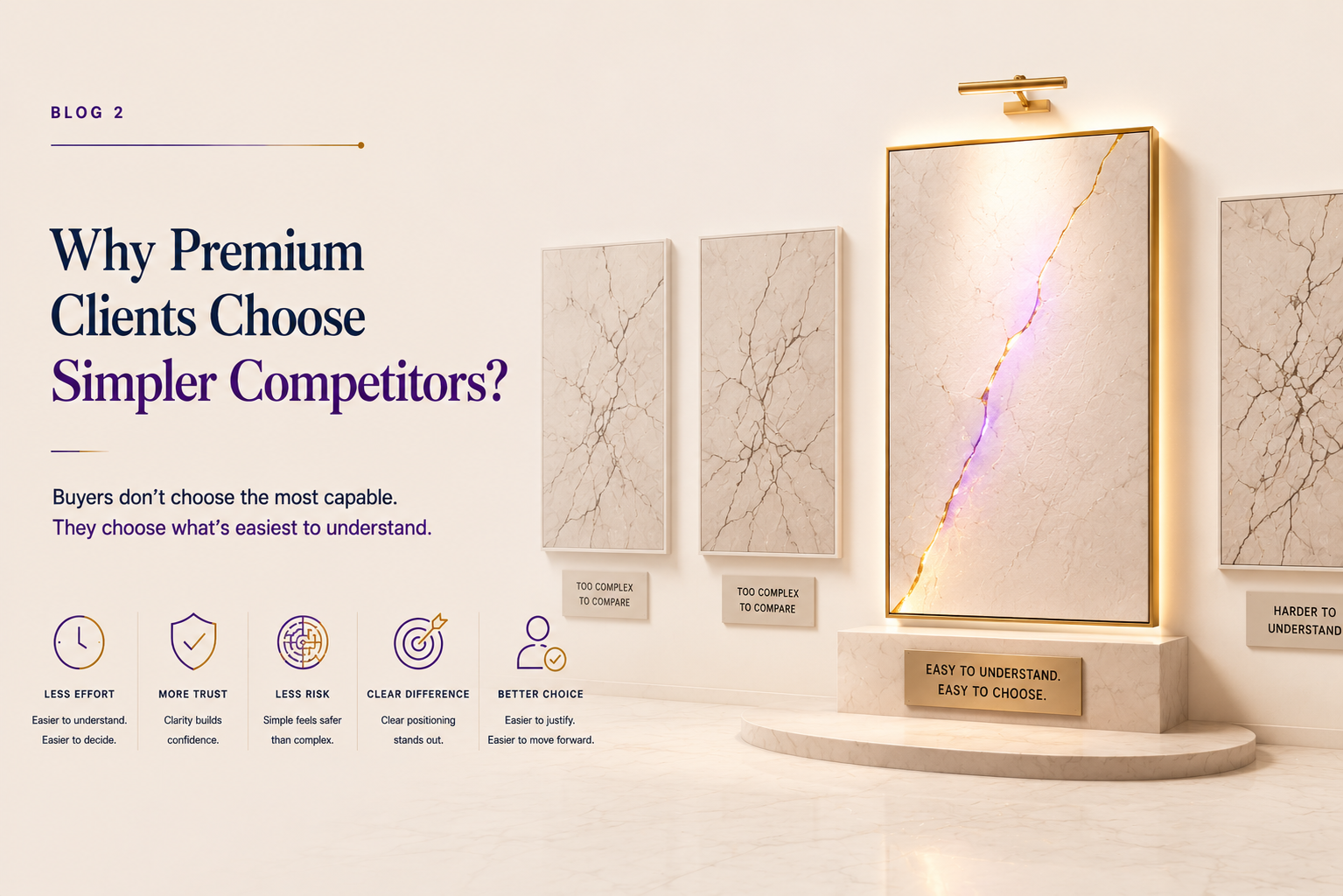
This is one of the reasons why premium clients often choose simpler competitors, not because those competitors are better, but because they are easier to understand.
The Difference Between Being Better and Being Easier to Buy From
Many businesses focus heavily on becoming better.
They improve their services, strengthen their teams, invest in technology, refine processes, and expand capabilities. These efforts are important because they improve the actual value delivered to clients.
However, there is another challenge that receives significantly less attention.
How easy is it for a prospective client to understand that value?
These are not the same thing.
A business can be highly capable and still be difficult to understand.
Similarly, a business can have fewer capabilities but communicate its value with remarkable clarity.
When buyers are evaluating multiple options, clarity often influences the first stage of decision-making.
The table below illustrates the distinction.
Business A | Business B |
More experience | Less experience |
Broader service portfolio | Narrower service offering |
Highly customised approach | Clearly defined solution |
Complex explanation | Simple explanation |
Strong capability | Strong clarity |
Many business leaders assume Business A should win.
Yet buyers frequently choose Business B.
Not because it is superior.
Because it is easier to evaluate.
Why Buyers Prefer Simplicity
The word “simplicity” often creates the wrong impression.
It does not mean reducing expertise.
It does not mean oversimplifying complex work.
And it certainly does not mean presenting a business as less sophisticated than it actually is.
Simplicity, in a business context, refers to clarity.
It means helping buyers understand the value being offered without requiring significant effort.
Every purchasing decision involves a degree of uncertainty. Buyers must assess risk, justify decisions internally, compare alternatives, and predict future outcomes.
When a business is difficult to understand, buyers face an additional challenge.
They must first understand the business before they can evaluate it.
That extra effort often creates friction.
And friction influences decisions.
The Four Reasons Premium Clients Choose Simpler Competitors
1. Clarity Reduces Decision-Making Effort
Premium clients are often senior decision-makers with limited time and multiple priorities.
They are not looking for the most detailed explanation.
They are looking for confidence.
A clear value proposition allows buyers to quickly understand:
- What problem is being solved
- Why the solution matters
- Whether the solution is relevant
- Why they should consider the provider
Businesses that communicate these points clearly reduce the effort required to move forward.
2. Buyers Trust What They Understand
Trust is frequently associated with credentials, testimonials, experience, and expertise.
While these elements matter, they are not always the starting point.
People tend to trust information they understand.
When communication becomes overly complex, buyers struggle to connect expertise with relevance.
The result is often hesitation rather than confidence.
This is why many highly capable organisations fail to communicate the value they have already created.
3. Complexity Creates Perceived Risk
Most businesses believe complexity demonstrates capability.
Unfortunately, buyers often interpret complexity differently.
When a business is difficult to explain, difficult to compare, or difficult to understand, it may unintentionally appear risky.
Questions begin to emerge.
Will implementation be complicated?
Will communication be difficult?
Will the project become more complex than expected?
Can the organisation deliver what it is describing?
These concerns may never be expressed directly, but they influence decision-making nonetheless.
4. Differentiation Gets Lost in the Details
One of the most common communication mistakes in B2B businesses is assuming that more information automatically creates more understanding.
In practice, the opposite often occurs.
When businesses attempt to communicate every capability, every service, every process, and every achievement simultaneously, the message becomes diluted.
The market remembers less.
Differentiation becomes harder to identify.
Buyers leave conversations understanding activities rather than outcomes.
As a result, businesses that should appear unique often sound remarkably similar to everyone else.
How Businesses Accidentally Create This Problem
Few organisations intentionally make themselves difficult to understand.
The challenge usually emerges through growth.
As businesses evolve, they add services, expand industries, develop new expertise, and respond to client demands.
These changes strengthen the organisation.
However, communication rarely evolves at the same pace.
Over time, businesses continue describing themselves in ways that made sense years ago but no longer reflect who they have become.
This creates a gap between capability and perception.
Internally, the business understands its value.
Externally, the market struggles to see it.
This gap is often mistaken for a marketing problem.
In reality, it is frequently a business differentiation problem.
Questions Every Business Should Be Able to Answer
Strong business differentiation begins with clarity.
Before investing in more marketing, content, or visibility, organisations should be able to answer the following questions clearly.
Question | Purpose |
What problem do we solve? | Establish relevance |
Who is our solution designed for? | Create audience alignment |
Why does this problem matter? | Build urgency |
Why is our approach different? | Create differentiation |
Why should buyers trust us? | Build confidence |
If these questions require lengthy explanations, there is usually an opportunity to improve clarity.
The objective is not to simplify expertise.
The objective is to simplify understanding.
Conclusion
The strongest businesses do not always win because they are the most capable.
They often win because they are the easiest to understand, compare, and trust.
As markets become increasingly crowded and buyers become increasingly time-conscious, clarity becomes a competitive advantage. Businesses that communicate their value clearly are not reducing their expertise. They are making it easier for the market to recognise it.
The challenge for growing organisations is not becoming more capable. Most are already doing that successfully. The challenge is ensuring that the market understands those capabilities with the same level of clarity with which the business understands them internally.